AI Can’t Tell You If Your Partner Is a Narcissist

No matter your core thoughts about AI and its usage, it is being used as a tool by many people for many different things. The realm of what AI can do seems almost unlimited, until we get to the one thing it simply cannot be: human.
A client coming in with “I pasted our text conversation into ChatGPT and asked, ‘Is my husband a narcissist?’...” or “I told AI everything that happened. It said my wife is emotionally abusive…” is significantly different from someone who may utilize AI as a journal-type tool to distill or prompt introspective work. I've had many clients utilize AI to move through what they want to talk about during their sessions, and I've seen both sides of it. Sometimes it helps.
Other times, I see more harm than good.
Now, it makes total sense that people find themselves asking AI the more complex questions. It is hard to tell the difference between, “Something is wrong here” and “I'm hurt and interpreting everything through that hurt.” AI feels appealing because it's immediate, available, and willing to listen to the entire story… your story. This is a part of the complexity of utilizing AI as a relational tool.
AI wasn’t in the room. It doesn't know your partner. It definitely doesn't have the six years of context behind this particular argument and AI can't reliably diagnose someone based on a conversation you pasted into a chat window...
I know that is frustrating.
“Great, so just no support from AI when it comes to my relationship!?” Not at all what I mean.
Let’s talk about some great myths of AI and relationships:
MYTH #1: “AI can tell me whether my partner is a narcissist.”

The reality is that AI can help you identify behaviors, but it can't reliably diagnose a person or determine the underlying cause of those behaviors.
This is where you can distinguish:
“My partner repeatedly dismisses my feelings.”
“My partner uses insults during conflict.”
from:
“My partner is a narcissist.”
“My partner has an avoidant attachment style.”
“My partner is intentionally gaslighting me.”
The first set describes observable behavior and the second set makes conclusions about personality, diagnosis, motivation, or intent. That's an important distinction in therapy, too. It is okay, if you are drawn to use AI, to use it to explore behavior.
Just be very cautious about using it to label people.
MYTH #2: “If AI agrees with me, that means I'm right.”

If someone tells AI, “My husband ignored me for four hours because he doesn't care about me. Isn't that emotionally abusive?”, now the AI has been handed a conclusion before it can process the facts of the question.
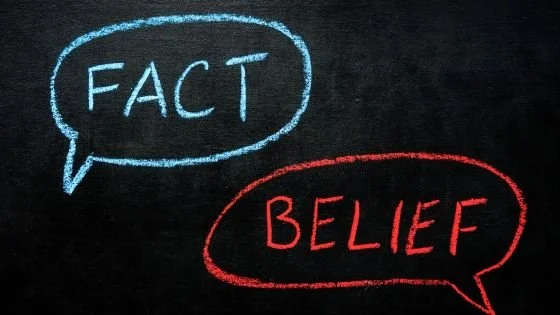
There's a difference between the FACT of “He didn't respond for four hours.”, the FEELING of “I felt rejected and unimportant.” and the INTERPRETATION of “He didn't respond because he doesn't care about me.”
Those are not interchangeable statements.
AI can help someone separate those pieces, but it can also inadvertently reinforce the story if the user is primarily asking it to confirm what they already believe. This is called confirmation bias. And AI is a predictive algorithm designed for essentially this purpose, unless expressly told otherwise. It provides the answer by following the lead of the information and context you present. Instead of asking, “Am I right?”, try asking, “What assumptions might I be making?” or “Give me three possible interpretations of this interaction.” That turns AI from a confirmation machine into a tool for shaping your own perspective.
MYTH #3: “AI can replace couples therapy.”

AI can be super useful between therapy sessions, but it can't replicate the therapeutic relationship between you, a partner, and your therapist. In fact, it can easily derail progress or insights of the therapist who has the ability to observe and hold all of the relational context. It invites an uninformed “interpreter” to the team.
That said, AI can really be a supportive tool. It can help someone:
organize their thoughts
identify what they're feeling
prepare for a difficult conversation
practice how to say something
create journal prompts for introspection
recognize when they're becoming emotionally flooded
brainstorm questions to bring to therapy
slow down before sending an angry text
consider another person's perspective
But a therapist brings something AI fundamentally doesn't, a relationship. The therapeutic relationship, in itself, is intended to be a healing one. Therapy is not simply the exchange of information, the relationship itself is part of the work. A therapist can observe interaction and notice patterns, allowing them to track changes over time. A therapist is able to challenge both partners and notice when someone's words and body language don't match. Every session comes with reading the room, the body language and the ease or tension. Sometimes you pause session based on how one person shifted in their seat. Non-verbal cues. Therapists are also able to understand the history of each individual and the couple together. Beyond all of this, a therapist is able to hold both people accountable rather than simply responding to the person typing.
AI can be a tool in someone's therapeutic toolbox…it shouldn't become the toolbox.
MYTH #4: “AI relationship advice is inherently unhealthy.”

Eh, not necessarily. Really, technology itself isn't necessarily the problem. How we use it matters. How we use it is everything! Someone might use AI in a healthy way by prompting something like, “I'm furious with my partner and I'm too activated to have this conversation productively. Help me figure out what I'm feeling before I talk to them.”... Yes, love this. Do this!
That's very different from, “Here are 37 screenshots of my husband's texts. Prove that he's a narcissist.”... No. We do not love this. Don’t do this!
One promotes self-reflection. The other outsources judgment. We want more self-reflection and introspection than judgment or conclusive statements about our partners or our relationships.
MYTH #5: “AI can tell me what my partner really meant.”
So, actually AI can't read minds, and major bummer, neither can we. It is important to separate the intent vs. impact it has on you. Maybe your partner DID say something hurtful and the impact may be completely real, “That hurt me.” But the explanation for why they said it might not be obvious. Was it defensiveness? Fear? Anger? Carelessness? An attempt at humor? An old conflict pattern? Intentional cruelty? You don't necessarily know and AI doesn't know either.
So instead of, “Why did my husband do this?” A much more useful question might be, “What are some possible explanations for this behavior, and what could I ask my partner to better understand what happened?” That moves you towards curiosity rather than certainty. A much better place to learn from.
MYTH #6: “AI should tell me what to do.”

Nope. AI can help you THINK through choices. It shouldn't make your relationship decisions for you. Louder for those in the back, AI SHOULD NOT MAKE YOUR RELATIONSHIP DECISIONS FOR YOU! Instead of, “Should I leave my marriage?”, someone could ask, “Help me think through the factors I should consider.” or, “What questions should I ask myself before making this decision?”, or, “What would staying, separating, or seeking therapy each potentially involve?”.
AI can help organize a complicated decision without becoming the person who makes it.
There is one important consideration: if you're dealing with violence, coercive control, threats, or concerns about your physical safety, an AI conversation should not be your primary source of support or safety planning. Those situations warrant appropriate professional and real-world resources.
So what is AI good for in relationships?
AI can be a relational brainstormer.
Instead of:
“Is my partner toxic?”
Try:
“What behaviors in this interaction concern me, and why?”
Instead of:
“Who is wrong?”
Try:
“What might each person be experiencing here?”
Instead of:
“Is this gaslighting?”
Try:
“Help me distinguish between disagreement, defensiveness, invalidation, and manipulation.”
Instead of:
“What should I say to make my partner understand?”
Try:
“Help me communicate this without blame or escalation.”
Instead of:
“Should I leave?”
Try:
“Help me identify the questions I need to answer before making this decision.”
If you really want a fun one, ask AI to “Challenge my interpretation”... this I have had people learn from!
The Bigger Point
AI is a mirror, not a witness.

AI can reflect back what you bring to it and it can absolutely help organize your thoughts. It can even be helpful in recognizing patterns and introducing you to possibilities you hadn't considered. Even better, it can help you find language for something you couldn't articulate. But, it wasn't there. It doesn't know your partner's internal experience and it certainly doesn't know the whole relationship. AI cannot independently verify the story being presented.
So perhaps the healthiest way to use AI relationally isn't to ask it, “Tell me what my partner is.” It's to ask, “Help me understand what is happening, including what I might be missing.”
The most valuable thing AI may offer us in our relationships isn't an answer really, it's another opportunity to slow down. Before we decide our partner is narcissistic, ask what actually happened. Before we decide they don't care, ask what we know and what we're assuming. Before we decide we're completely right, ask what we might be missing. And before we ask AI to tell us what to do, ask ourselves what we need to understand first. AI can help us think about our relationships, it just can't have them for us.
My name is Jaimi Douthit and I’m a Licensed Professional Counselor at the Center for Couples Counseling. I love working with couples and individuals who are ready and motivated to make changes in their lives and relationships, who can handle feedback and encouragement, and engage in using the tools I teach in therapy outside of the therapy room. At the Center for Couples Counseling, we specialize in couples therapy, infertility counseling, postpartum mood and anxiety disorders, self-care and burnout, and perfectionism. We help couples and individuals in the League City and Houston areas in person, and all residents of the State of Texas online. Call us at (832) 827-3288 to schedule a free phone consultation.
Begin Couples Therapy in League City, TX
We know relationships take a lot of hard work. But your relationship is important and deserves the effort. At Center for Couples Counseling we want to help you and your partner get back on the right track. To get started with in-person or online couples therapy follow these simple steps:
Meet with one of our skilled couples therapists
Begin to see positive changes in your relationship
Other Services Offered at Center for Couples Counseling
At the Center for Couples Counseling, we understand you or your relationship may be facing different challenges. To help you work on yourself and your relationship, our Texas practice offers individual therapy, infertility counseling, postpartum anxiety, and depression counseling, therapy for self-care and burnout, and therapy for perfectionism. For more about us check out our FAQs and blog!