
The Power of Connection: How Co-Regulation and Gratitude Shape Our Relationships
Have you ever had one of those days when everything feels like a little too much? Maybe work was stressful, the kids were pushing every button, the dog pooped in the house again, or life simply wasn't going according to plan. Then someone you love walks into the room, gives you a hug, and somehow things feel a little less overwhelming.
They didn't fix anything. The circumstances haven't changed. But something about that connection helped.
There is actually a reason for that, and it has a lot to do with how our brains and nervous systems are wired.
We Were Never Meant to Handle Everything Alone
We hear a lot about emotional regulation and learning how to manage our own emotions. And while those skills are important, we sometimes forget that human beings are designed for connection. From infancy, we rely on other people to keep us safe, help us feel understood, and provide comfort.
This is called co-regulation. Simply put, co-regulation happens when we help one another navigate emotions and stress through our presence, responses, and interactions.
Our nervous systems are constantly taking in information from the environment around us. The tone of someone's voice, their facial expressions, their body language, and even a reassuring touch can influence how safe or threatened we feel. When we are stressed, our bodies may move into a heightened state of alertness. Our heart rate increases, our muscles tense, and we may become more reactive or withdraw completely.

Connection can help us settle. A calm voice, a patient response, or simply knowing someone is there can help reduce the emotional weight of a difficult moment. Our brains are continually processing these social cues, and supportive relationships can make it easier to navigate stress.
What Does This Look Like Between Partners?
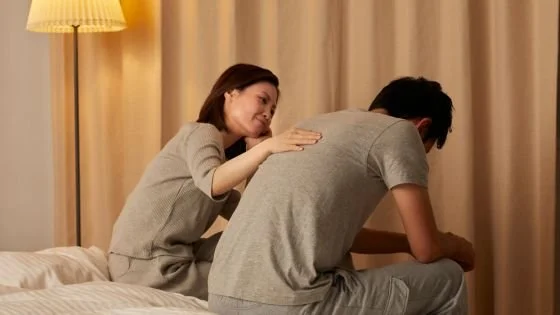
Co-regulation isn't grand romantic gestures or perfectly timed words of encouragement. More often, it happens in the ordinary moments.
It looks like lowering your voice when a disagreement starts getting heated instead of matching your partner's frustration. It might mean reaching for their hand, offering reassurance, or simply saying, "We're on the same team. Let's figure this out together."

Of course, sometimes both partners are overwhelmed, both are frustrated, and neither feels particularly equipped to offer comfort. In fact, research found that people within a close system can influence each other's physiological stress responses, meaning stress can often spread just as, and maybe more easily, than support and calm can.
The goal isn't to have one partner constantly responsible for keeping the other calm. Healthy co-regulation involves both people learning to recognize their own emotions while also creating an environment where each person feels safe enough to express them.
Sometimes the most meaningful thing we can offer our partner isn't a solution. It's the reassurance that they don't have to face the difficult moment alone.
And What Does Gratitude Have to Do With It?
This is where things get interesting. Gratitude may seem like an entirely different topic, but it has a meaningful connection to how we experience stress, relationships, and emotional well-being.
Our brains are constantly scanning for information. When life becomes overwhelming, our attention can become focused on everything that is going wrong, everything that needs to be done, and everything we wish were different. This isn't a character flaw; it's part of how our brains help us identify and respond to potential problems.

Practicing gratitude gives us an opportunity to broaden that perspective.
Neuroscience research has linked gratitude experiences with activity in brain areas involved in emotional processing, decision-making, and social connection. Researchers have also begun exploring how gratitude practices relate to physiological responses, including heart rate variability, which offers insight into how the body responds to stress.
Gratitude doesn't erase difficult emotions or magically make stressful situations disappear. It simply gives us another place to direct our attention.

And in relationships, that can make a difference. When loved ones feel appreciated, they often become more responsive and more willing to show appreciation in return. Think about the difference between hearing what you're doing wrong all day and hearing, "I noticed how hard you've been working, and I appreciate you." Those words may seem small, but feeling seen and valued can strengthen emotional connection.
A Little Something to Try Together
This week, try setting aside five minutes with your partner. Put away the phones and take turns sharing three things:
Something your partner did recently that you appreciated.
A moment when you felt especially connected to one another.
One small thing you can do tomorrow to help each other feel supported.
Try listening without jumping in, correcting, or turning the conversation into a discussion about what needs to change.
And remember, gratitude doesn't mean pretending everything is wonderful. Sometimes gratitude comes after the difficult moment, not during it. We can acknowledge that a season of life was painful while still recognizing the people who walked alongside us through it.
We can't always control the stressors that enter our lives, but we can be intentional about how we show up for one another.
Sometimes a calmer nervous system, a stronger relationship, or a little more emotional breathing room begins with something surprisingly simple: feeling seen, appreciated, and knowing we aren't alone.
My name is Carrie Yost and I am currently pursuing a Master of Science in Clinical Mental Health Counseling with a concentration in Rural Mental Health at Texas A&M University–Kingsville. I earned my Bachelor of Science in Criminology, graduating with honors from the University of Houston–Clear Lake. I am working at The Center for Couples Counseling under the supervision of Erika Labuzan-Lopez. I empower clients through compassion, collaboration, and respect for the path we discover together. If you’re looking to grow with a kind compass, call (832) 827-3288 to set up your free phone consultation. Our Center serves couples and individuals in League City and Houston, Texas and all residents of Texas online!
Interested in Meeting a Couples Therapist in League City, TX?
If you want to improve your relationship and reconnect with your partner, take action now and start being more curious about your relationship. At Center For Couples Counseling, one of our skilled couples therapists can help you and your partner navigate your challenges and rediscover the curiosity and passion that brought you together in the first place. Don't wait any longer to invest in the health and happiness of your relationship. To meet with a couples therapist follow these three simple steps:
Contact us to schedule an appointment
Meet with one of our skilled couples therapists
Begin to find the curiosity in your relationship and reconnect with your partner!
Other Services Offered at Center for Couples Counseling
At Center For Couples Counseling, our team of skilled therapists understands that your relationship may be facing different challenges. In addition to couples therapy, our Texas practice offers individual therapy, infertility counseling, postpartum anxiety and depression counseling, therapy for self-care and burnout, and therapy for perfectionism. For more about us check out our FAQs and blog!