Flooded Emotions: Why Shutting Down Actually Feels Better
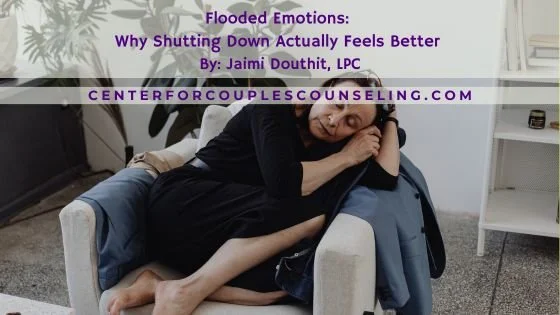
There’s a moment in some arguments where one of you is still talking… and the other one is just… not there anymore. Not literally… they’re still sitting physically there, maybe staring at the floor, maybe saying “I don’t know” on repeat… maybe just quiet in a way that feels louder than anything else happening.

And if you’re the one still trying to talk? It’s overwhelmingly maddening. You might find yourself feeling like, “Why are you shutting down?”, “Can you PLEASE just say something?!” or “Do you even care about this at all?”
But if you’ve ever been the one on the other side of that moment, the experience is completely different. It doesn’t feel like you’re choosing to shut down. It feels like your brain just… left… poof. Like the conversation got too loud, too fast, too much and something in you hit a big and solid wall.
You try to think of what to say, and there’s nothing there. Or what is there feels… wrong. Risky move. Like if you say it, it’s going to make everything worse…so you stop talking. This isn’t about punishment or avoidance… it’s just that continuing feels literally impossible. Here’s the part that doesn’t get talked about enough: Shutting down can actually feel better in that moment.
Not good. Not resolved. Not peaceful. But better than staying in something that feels overwhelming. It’s like your system goes, “Nope. We’re done here.” And everything just… narrows.

Less input.
Less emotion.
Less risk.
Why do we shut down?
Because when you’re that overwhelmed, less feels safer. Absolutely fair! From the outside, though, it doesn’t look like that. It looks a lot like something else… like maybe you don’t care, or you’re avoiding… or even refusing to engage. That’s where things start to spiral! The person sitting across from you isn’t experiencing your relief, they’re experiencing your absence. And absence in the middle of conflict? That’s super hard to take in and just… sit with. So they try to pull you back in with more questions, repetition, or an obvious push for that one something they know is there. Anything. And the more they push, the more your system goes, “This is exactly what I can’t handle right now.” So you go quieter. Or flatter. Or completely still. And now you’re both stuck with one person reaching and one person disappearing. Neither of you getting what you actually need.

This is where it helps to zoom out for a second.
This isn’t about one person being “better at communication” than the other. It’s about two nervous systems having very different responses to the same moment. One moves toward to feel better. One pulls away to feel better. Both make sense, actually. However… when both happen at the same time neither gets the relief they’re looking for.
So, what actually helps?
If you’re the one who shuts down, the goal isn’t to force yourself to suddenly have words when you don’t. It’s to catch it just a second earlier…before you fully disappear.

Even something like:
“I’m starting to feel really overwhelmed. I’m not trying to ignore you…I just need a minute.”
It doesn’t have to be perfect. It just has to be something. That small signal changes the entire moment…it lets your partner know you’re still there, even if you can’t fully engage right now.
If you’re the one on the other side, the one trying to get through to someone who just went quiet, I get why you push. Silence in those moments feels like rejection… like disconnection … like things are slipping further away instead of getting resolved. The thing is… pushing for more when someone is shutting down is like trying to speed up a system that’s already overloaded.
It doesn’t bring them back. It pushes them further out.
Release the Pressure Valve

What helps more (even though it feels less satisfying in the moment) is lowering the intensity just enough for them to come back. Something like, “Hey… I can see this is a lot. We don’t have to figure it out right this second.” That doesn’t mean the conversation disappears, it means you’re giving it a better chance.
Just like we talked about before, connection doesn’t happen when someone is flooded and it also doesn’t happen when someone has checked out just to get through the moment. But it does come back. When there’s a little less pressure and a little more space… and a shared understanding that neither of you is the enemy here.
So if you’ve been the one shutting down, or the one sitting across from it, you’re not doing it wrong. You’re in a pattern and what is cool about patterns is that patterns can change. Not by forcing more words in the moment… but by knowing when the moment needs to breathe first.
My name is Jaimi Douthit and I’m a Licensed Professional Counselor at the Center for Couples Counseling. I love working with couples and individuals who are ready and motivated to make changes in their lives and relationships, who can handle feedback and encouragement, and engage in using the tools I teach in therapy outside of the therapy room. At the Center for Couples Counseling, we specialize in couples therapy, infertility counseling, postpartum mood and anxiety disorders, self-care and burnout, and perfectionism. We help couples and individuals in the League City and Houston areas in person, and all residents of the State of Texas online. Call us at (832) 827-3288 to schedule a free phone consultation.
Begin Couples Therapy in League City, TX
We know relationships take a lot of hard work. But your relationship is important and deserves the effort. At Center for Couples Counseling we want to help you and your partner get back on the right track. To get started with in-person or online couples therapy follow these simple steps:
Meet with one of our skilled couples therapists
Begin to see positive changes in your relationship
Other Services Offered at Center for Couples Counseling
At the Center for Couples Counseling, we understand you or your relationship may be facing different challenges. To help you work on yourself and your relationship, our Texas practice offers individual therapy, infertility counseling, postpartum anxiety, and depression counseling, therapy for self-care and burnout, and therapy for perfectionism. For more about us check out our FAQs and blog!